Determining adequate tightening torque for ISO-KF clamp connections, with size-based reference ranges and practical “enough” criteria.


You hear a satisfying click when a vacuum joint mates perfectly. It’s a tactile confirmation of a tight seal, requiring minimal effort. But if you’ve ever found yourself reaching for a longer wrench, or pressing your body weight against a clamp just to get two fittings to meet, you’ve already strayed into dangerous territory.
I recently walked through a university thin-film deposition lab where a post-doc showed me a scarred, warped clamping ring. "We just needed a temporary bypass," he explained, "so we used an adapter we had lying around." The mismatch looked small on paper, just a few millimeters. But to make it fit, they had to crank the wing nut down so hard that the metal yielded. The result wasn't just a broken clamp; it was a hairline crack in the viewport flange that cost the research group three weeks of downtime.
That scarred ring is the perfect symbol for a widespread but rarely discussed problem: forced assembly. This is the practice of using brute force to connect components that aren’t dimensionally compatible, and it’s a primary cause of catastrophic vacuum failure.
Vacuum components are not plumbing. In household plumbing, a bit of Teflon tape and an extra quarter-turn can seal a slight mismatch. In vacuum systems operating at high or ultra-high levels, sealing relies on the elastic deformation of an O-ring against perfectly smooth, geometrically precise knife-edges.
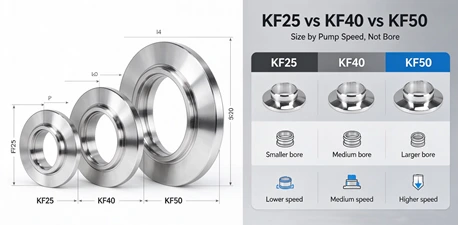
The standard that governs these dimensions is largely based on the ISO-KF (ISO 2861) standard. It dictates not just the nominal diameter, but the exact angle of the conical seat, the depth of the groove, and the surface finish. When you attempt to join two mis-sized ends—say, a KF-25 to a KF-40—you aren't just dealing with a diameter difference. You are creating:
Zero-distance metal-to-metal contact: The knife-edge of the larger flange slams directly into the flat face of the smaller one before the O-ring ever touches down. This scores the sealing surface.
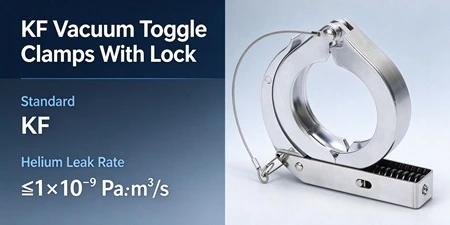
Asymmetric clamping pressure: The hinged clamp is designed to close over two identical mating flanges with a specific outer diameter. On a stepped mismatch, the clamp sits angled, applying a force vector that pushes the flanges apart rather than pulling them together.
Virtual leak creation: A deformed O-ring often forms a labyrinth that seals against a helium leak detector test but opens up gradually under thermal cycling, creating a frustrating "ghost leak."
There is a pervasive myth in workshops that if a high-quality vacuum clamp can physically span the width of the joint, it should work. This logic fails because it confuses structural capture with vacuum sealing.
Consider the failure mode of galling on stainless steel. When the passivation layer of a flange is scratched by a misaligned counterpart, the bare iron reacts with oxygen—or worse, corrosive process gasses—immediately. But the immediate danger is cold welding. Under high clamping pressure with a tiny contact patch, the two metals can actually fuse. The next time you try to disassemble the forced joint, you tear out a chunk of the flange. You now have a useless, expensive piece of hardware that cannot be repolished without breaking the dimensional tolerance.
This is not just an annoyance for research labs. In a pharmaceutical freeze-drying production line, a sudden loss of vacuum due to a fractured flange batch can destroy millions of dollars in product. The root cause is often traced back to a night-shift maintenance call where a technician "made it work" with the wrong size.
If you are currently dealing with a stubborn vacuum joint that requires excessive force, stop. Before you try to close that clamp, you need the right dimensional bridge to ensure the integrity of your vacuum envelope. Click here to view the complete dimensional compatibility chart and standard geometries.
This doesn't mean a KF-40 pump port can never connect to a KF-25 valve. The solution is never a forced clamp; it’s the correct reducer fitting.
A properly manufactured reducer is not just a cone with two ends. Internally, the transition section should have a gradual taper—typically a cone angle less than 20 degrees—to minimize turbulence and conductance loss. Suddenly stepping a gas flow path creates back pressure and can even cause particulate shedding from the sudden pressure change.
When selecting a reducer, check three things:
Conductance Calculation: For a vacuum system processing large volumes, a reducer acts as a choke point. Ensure the length of the central bore doesn't drop the effective pumping speed below your process threshold.
Structural Support: A large, heavy component (like a gas analyzer) attached to a small vacuum line via a reducer puts immense leverage on the smaller joint. Always support heavy components independently; the vacuum fitting is a seal, not a structural truss.
Material Traceability: If you are rebuilding a system that suffered a mismatch failure, ensure the new reducers come with material certificates (EN 10204 3.1), verifying the 304L or 316L grade. Cheap, low-nickel steel will corrode at the heat-affected zone of the taper weld.
To achieve the reliability your process demands, the simplest rule is the most ignored one: don’t mix sizes at the same connection point. Even with an adapter, the adapter itself creates two separate junctions. If a single-sized run is possible, it is always superior.
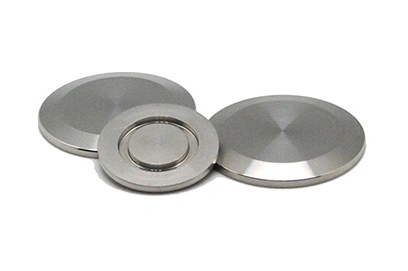
In semiconductor thin-film etching, for example, some critical process lines are specified with uniform-bore assemblies. This means the tube diameter and flange diameter never change from the chamber to the pump. This eliminates not only mechanical stress points but also dead zones where precursors can condense. It’s a principle borrowed from high-performance fluid dynamics: laminar flow requires consistent geometry.
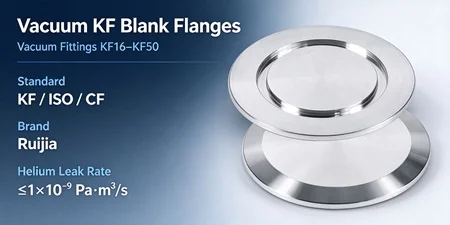
For most users, you can achieve a near-uniform state by modular design. Plan your vacuum line so that the main manifold runs a standard size, and only branch out into different sizes at blanked-off ports. This way, you don’t have reducers acting as in-line patch cables for pressure.
It’s common to inherit a lab or a plant floor with a chaotic mix of fittings. The first instinct is to "use them up." That’s a sunk-cost fallacy that risks your live projects.
To protect your system, perform a quick visual audit immediately. For every vacuum coupling that has already been torqued down, look for a visible step or lip at the clamp joint. If you can run a fingernail over the joint and feel an edge, the O-ring is improperly loaded. Mark that joint with a bright red zip tie and schedule it for replacement. Using quality connection components from the start prevents this reactive panic.
If you want a more rigorous approach, a go/no-go gauge set is a workshop game-changer. Before assembly, validate the outer diameter of the flange ends with the gauge. If the "go" side doesn't slide on smoothly for a specific nominal size, you haven't just found a build-up of debris; you may have a deformed lip from a previous forced assembly. This is the number one way to break the cycle of damage propagation—the bent flange that bends your next new clamp that bends your next new flange.
Ultimately, the elegance of a high-vacuum system lies in its precision. It shouldn’t smell like penetrating oil, and you shouldn’t hear the grunt of an operator straining against a wing nut. The seal is a physics phenomenon, not a mechanical one.
If you are tired of tracing virtual leaks and replacing warped clamps, it might be time to standardize on components that respect the ISO geometry without deviation. To see how modular solutions can fit into your existing setup, get a tailored configuration recommendation for your specific setup. The hours saved in leak detection will easily offset the minutes saved by the wrench.
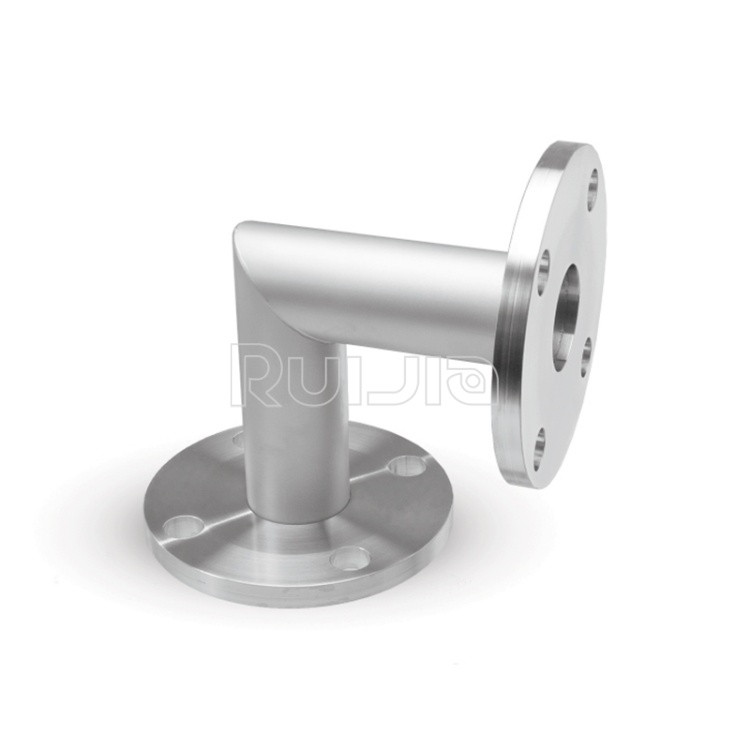
|
Temperature |
-26˚C to 200˚C |
|
Working Pressure |
Vacuum~atmosphere pressure |
|
Helium Leak Test |
1×10 -9 Pa・m³/sec or less |
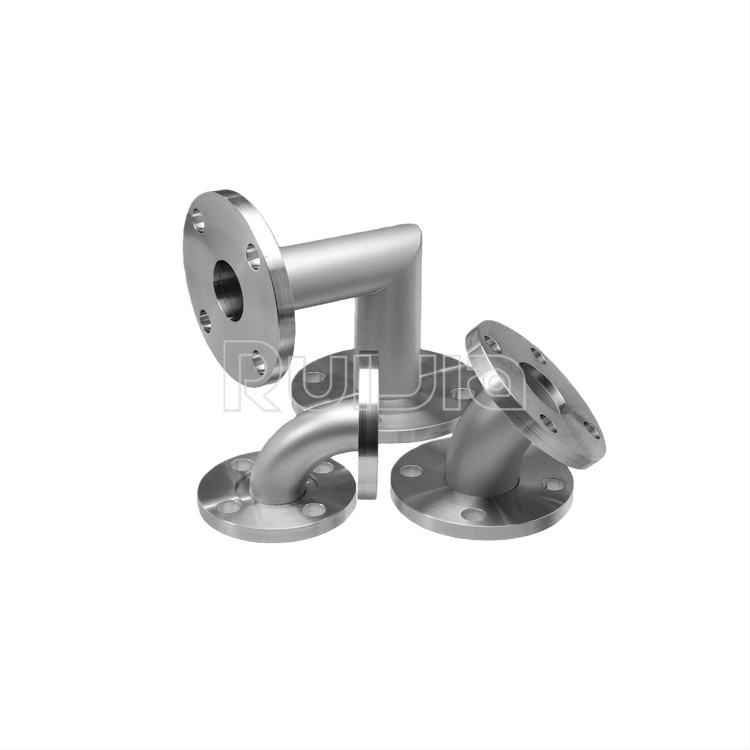
|
Temperature |
-26˚C to 200˚C |
|
Working Pressure |
Vacuum~atmosphere pressure |
|
Helium Leak Test |
1×10 -9 Pa・m³/sec or less |
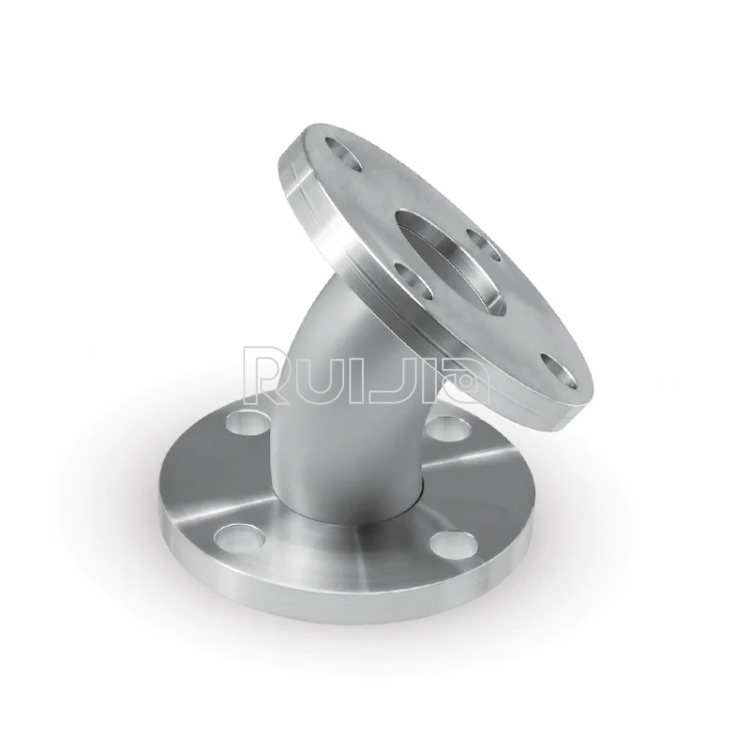
|
Temperature |
-26˚C to 200˚C |
|
Working Pressure |
Vacuum~atmosphere pressure |
|
Helium Leak Test |
1×10 -9 Pa・m³/sec or less |
Rich stock, fast delivery
Quick response within 24h
Quality assurance
Accessory replacement
GET A QUOTE